Developing Effective Third Down Offense and Quarterback Play without Elite
by Lonestar Coaches Network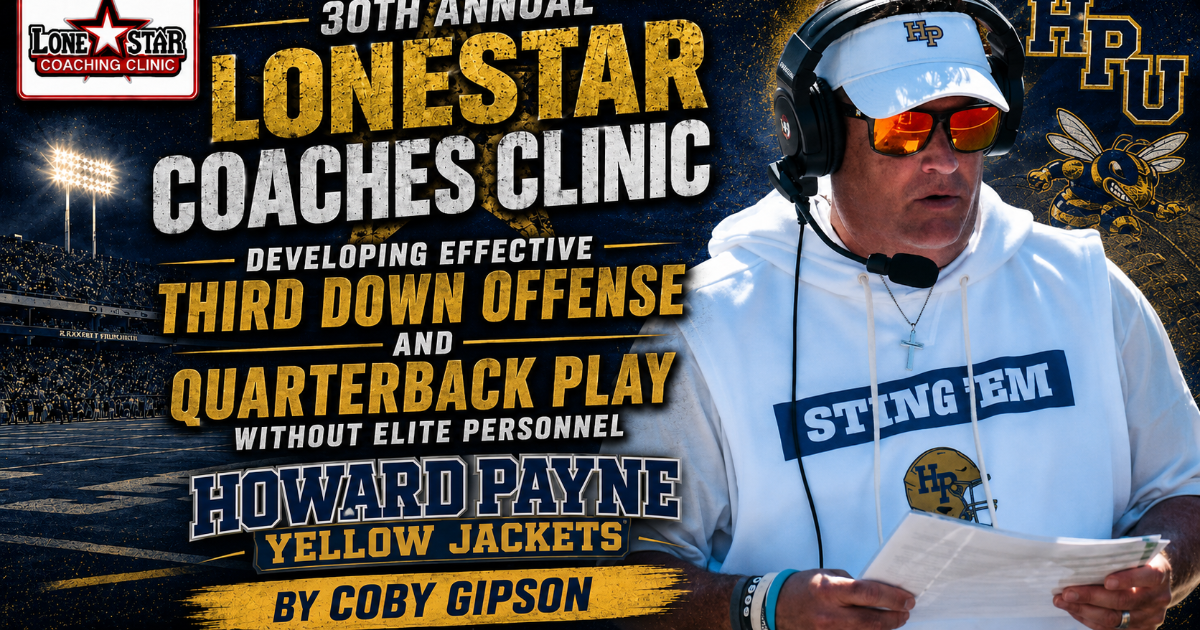
Description
-
Introduction & Philosophy: The speaker, a head football coach at Howard Payne University, discusses how to train quarterbacks and run a successful offense on third down, particularly when a team does not possess elite, "D1" or NFL-caliber prospects. He draws inspiration from the story of David and Goliath, emphasizing that success comes from preparation, background, attention to detail, and staying composed through adversity.
-
Slot Counter / GY Counter Play: The coach reviews a versatile play he has utilized for nearly 20 years across high school and college levels. Key strategies for execution include:
-
Aligning in a formation-in-the-boundary (FIB) look and targeting the slot receiver.
-
Ensuring the playmaker is exactly "three and three" away at the snap of the ball.
-
Teaching the quarterback to take a path that avoids a strict 90-degree angle into the hole and carrying out a highly convincing fake to draw defenders out of the box.
-
Modifying presentations to hide tendencies, such as running it out of a "no-back" set, using unbalanced lines with tight end shifts, adding a play-side tight end for a three-man surface, and utilizing "disco motion."
-
Developing a complementary pass option off the same look to force the defense to respect it.
-
-
Third and Long Protection & Concepts:
-
Seven-Man Full Slide Protection: Used against teams with exotic third-down looks. The quarterback uses a keyword to dictate the slide direction, while the tight end stays on the backside with the running back fitting off him to build a wall.
-
Route Variations: On the outside, teams can lock in go-routes, comebacks, or vertical read routes. On the inside, slot receivers can run a "mid read" or a "seam read" against one-high safety defenses, choosing to run a dig or beat the safety over the top based on defender placement.
-
Double Chip Scheme: Tight ends and running backs can double-chip elite edge rushers before releasing into the flat, buying the quarterback essential pocket time to deliver downfield strikes.
-
-
Short and High-Percentage Alternatives:
-
Slants and Swings: Against heavy zones, running a quick three-step slant to the boundary paired with a running back bubble or swing route gives the quarterback a safe, low-risk conversion option.
-
Third-Down Mesh and Slide Routes: Utilizing mesh concepts or introducing a running back on a slide route behind a bunch formation helps get the ball to playmakers in space without risking deep downfield throws.
-
Red Zone Spot Concept: Condensing the outside receiver in a 3x1 set opens up the middle of the field on a corner route, clearing space for an inside dig.
-
Double Post Over: Combining a spray post, a take post to freeze the safety, and an over route creates high-low windows against linebackers.
-
Spot Screens & Vertical Delays: Simple, quick-touch perimeter screens leverage blocking angles, while a "Y-delay" vertical concept clears out the defense to let a tight end late-release to the hash mark.
-
-
Tempo and Run-Pass Options (RPOs):
-
One-word tempo calls keep offensive linemen in basic inside zone rules while giving the quarterback quick perimeter keys like a bubble screen, a hitch route, or a "bubble glance" (where receivers chase open grass in five steps) to bypass complex third-down defensive schemes.
-
Utilizing gap scheme RPOs, zone locks, and double H-back formations with "alley, seal, safety" blocking rules forces defenses to respect the run game on third down.
-
-
Formations and Motion Variations:
-
Unbalanced Sets: The coach suggests using unbalanced lines roughly 20% of the time, often shifting early in the game to force the defense to reveal their limited unbalanced checks.
-
Sugar Package: A fast-break, under-center 12-personnel huddle scheme used in short-yardage scenarios. Every play utilizes jet motion, and plays are named after Texas cities (e.g., "Plano" for power, "Dallas" for duo) to communicate fast and out-tempo defensive adjustments.
-
-
Coaching Mentorship: The speaker concludes by emphasizing that coaches must embody the values they teach. He urges fellow coaches to intentionally manage their schedules to ensure they are successful husbands and fathers at home, rather than letting the demands of football compromise their personal lives.
This Course Includes
| 24 hours on-demand video |
| Streaming from mobile and TV |
| Lifetime access |
| Certificate of completion |
| 100% money back guarantee |
Course Info
| Rating: | (0) |
|---|---|
| Caterory: | Football/Quarterback Training |
| Duration: |